
This is an old revision of the document!
Adsorption of acetylene on an intermetallic surface
«
The reaction is the following:
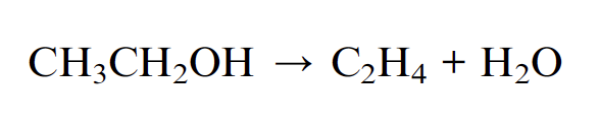 and this is the pictorial view in the gas phase:
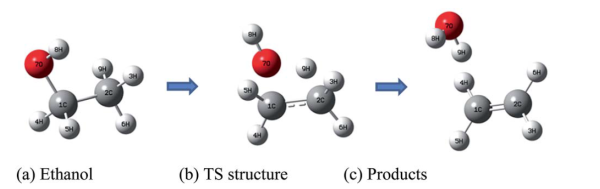
In the supplementary material of the paper, which can be found here, several calculation with different methods ranging from DFT to hybrid methods to high-level methods are described, together with the basis set dependence of the results.
We will compare our results with the published ones.
The input file structure is shown below:
&FORCE_EVAL                           ! This section defines method for calculating energy and forces

   METHOD Quickstep                   ! Electronic structure method (DFT,...)
   &DFT
      BASIS_SET_FILE_NAME ./BASIS_C_H_O
      &POISSON                        ! Solver requested for non periodic calculations
         PERIODIC NONE
         PSOLVER  WAVELET             ! Type of solver
      &END POISSON
      &QS                             ! Parameters needed to set up the Quickstep framework
         METHOD GAPW                  ! Method: gaussian and augmented plane waves
      &END QS

#
# Include the exchange and correlation information
#
@INCLUDE './hf.inc'

   &END DFT


   &SUBSYS                            ! This section defines the system
      &CELL                           ! Unit cell set up
         PERIODIC NONE                ! Non periodic calculation
         ABC 10 10 10                 ! Lengths of the cell vectors A, B, and C
      &END CELL
      &COORD                          ! This section specify all the atoms and their coordinates
  H         2.5558925119        3.0          4.
  O         4.00                3.5          4.
  H         5.4167134504        3.0669045998 4.
      &END COORD
      &TOPOLOGY
          &CENTER_COORDINATES
          &END
      &END TOPOLOGY


      &KIND O                                      ! potential and basis for O
         BASIS_SET _MYBASIS_
         POTENTIAL ALL
         &POTENTIAL
     4    4    0
     0.24762086    0
         &END
      &END KIND
      &KIND H                                      ! potential and basis for H
         BASIS_SET _MYBASIS_
         POTENTIAL ALL
         &POTENTIAL
          1    0    0
          0.20000000    0
         &END
      &END KIND
      &KIND C                         ! potential and basis for C
         BASIS_SET _MYBASIS_
         POTENTIAL ALL
         &POTENTIAL
            4    2    0
            0.34883045    0
         &END
      &END KIND
   &END SUBSYS
&END FORCE_EVAL                     ! This section defines method for calculating energy and forces

&GLOBAL                             ! Section with general information regarding which kind of simulation to perform an parameters for the whole PROGRAM
   PRINT_LEVEL LOW                  ! Global print level
   PROJECT h2o                      ! Name of the project. This word will appear as part of a name of all ouput files (except main ouput file, specified with -o option)
   RUN_TYPE GEO_OPT                 ! Geometry optimization
&END GLOBAL
The exercise is executed on the virtual machine cluster. After creating a directory as usual, you can download the file from here: (tar file)
Copy the file to the created directory in the EXERCISES path, and execute
tar xvf exercise_5.tar
h2o_template.inpfor the geometry optimization of waterethanol_template.inpfor the geometry optimization of ethanolethylene_template.inpfor the geometry optimization of ethylene (ethene)hf.incfile describing the level of theory (exchange and/or correlation functional), in this case Hartree FockBASIS_H_C_Oa repository file for basis sets.
First you have to modify the input files in order to prescribe a certain basis set. You have, from the simplest to the most advanced:
- 3-21G*
- 6-31G*
- 6-31Gxx
- 6-31++Gxx
- 6-311Gxx
- 6-311++Gxx
For example,
m_replace _MYBASIS_ '6-31G*' < h2o_template.inp > h2o_BASIS1.inp
(note: use the quote, because the star is a bash special character!!!) The command to launch the job is
In the *.out files you can look for the final energies by the following command:
.
This will list all the energies. Then you can redo the exercise with different basis set, reusing the command m_replace.
| Basis set | Energy H2O [$E_h$] | Energy Ethylene [$E_h$] | Energy Ethanol [$E_h$] | Distance CC Ethanol [$Å$] | Reaction energy [$E_h$] |
|---|---|---|---|---|---|
| BASIS 1(Name) | …. | …. | …. | …. | …. |
| BASIS 2(Name) | …. | …. | …. | …. | …. |
| BASIS 3(Name) | …. | …. | …. | …. | …. |
| BASIS 4(Name) | …. | …. | …. | …. | …. |
| BASIS 5(Name) | …. | …. | …. | …. | …. |
| BASIS 6(Name) | …. | …. | …. | …. | …. |
- Compute the reaction energy for the dehydration reaction of ethanol
- Prepare a table with rows and columns: on the rows the basis set, on the columns different quantities (see above).
- Compare the results with the published ones (note the conversion factors. You can use the tool at Energy converter
- Comment on the dependence on the basis set
- Is this information enough to determine the rates of reaction? Why?
BONUS TRACK
ethanol_BASIS1.inp into ethanol_dens_BASIS1.inp.
Add the following sections: under &DFT
       &PRINT
          &E_DENSITY_CUBE
          &END
       &END
       &SCF
          SCF_GUESS RESTART
       &END
This tells to read the old wavefunction and to print the cubefile of the density.
At the end of the input file:
&EXT_RESTART
     RESTART_FILE_NAME ./c2h6o-1.restart
&END
Then, change RUN_TYPE GEO_OPT to RUN_TYPE ENERGY to only run a single point calculation. It will generate a cubefile with the density which you may visualize with VMD.
→